
Embrace
A discreet, wearable solution designed to help individuals manage anxiety symptoms wherever they are through multi-sensory feedback.

Anxiety symptoms don't stay home, but the tools that help do
33% of over 84,000 college students across 135 institutions reported moderate or severe anxiety symptoms in 2024 to 2025. The coping tools that actually work (weighted blankets, heating pads, cold water, tight hugs) are all home-bound. There's nothing for the exam room, the lecture hall, the presentation.
Existing pharmaceutical options help, but many students are resistant to medication or can't access it consistently. Non-pharmaceutical alternatives on the market address only one symptom mode at a time, and none are designed to be worn discreetly in public.
"It can go from 0 to 100 in a second, but not the other way around."
Survey respondent, Oct 2024"It's scary because it feels like it won't end at the moment, and if it's really bad, I can't be around other people."
Survey respondent, Oct 2024Research before product, always
Before committing to a single feature, we ran two structured surveys, four medical professional interviews, and a series of in-person prototype and MVP testing sessions with target users. The goal was to understand the lived experience of anxiety, identify what people already reach for, and test which sensory modalities resonated most.
A key research insight: anxiety is not a "one size fits all" problem. Symptoms varied widely, and what grounds one person agitates another. This validated an "and/or" approach to features rather than narrowing to a single modality. As one test participant put it after trying on the adjustable vest: "I like that it's adjustable. It really sticks with your plan that anxiety is not a one size fits all."
Nearly half of survey respondents (46%) were already using some combination of weighted blankets, heating pads, stress balls, fidget toys, or vagus nerve stimulators to self-manage symptoms. This is DIY evidence that the category already exists, fragmented across single-purpose products. Embrace's job was to consolidate what people had already validated for themselves into one wearable.
A non-medicated, on-the-go approach for anxiety relief
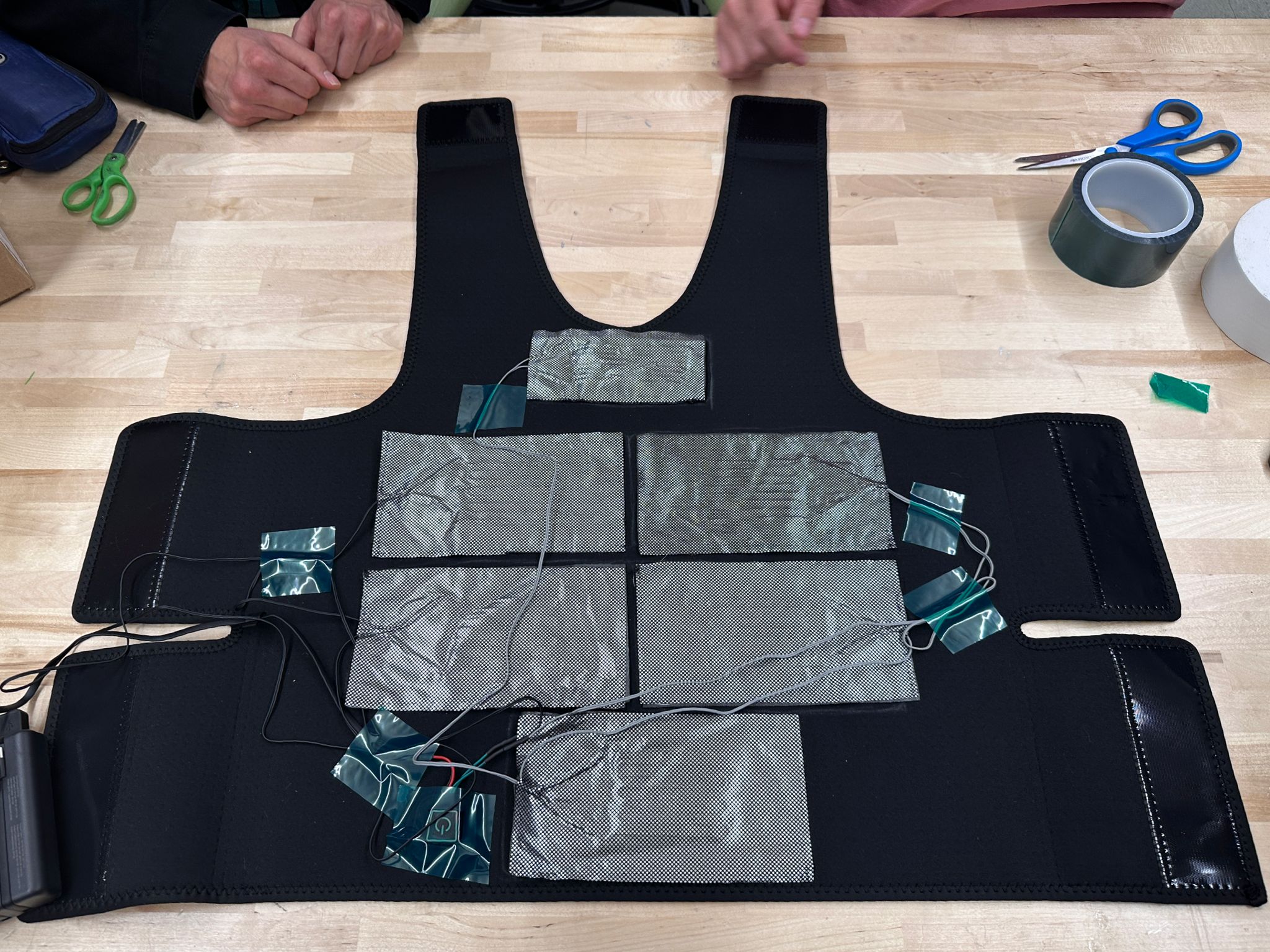
Embrace is a discreet wearable vest delivering four independently controllable sensory modalities: compression, cooling, warmth, and vibration. Each can be activated individually or in combination, allowing users to personalize their response to whatever their body needs in the moment, without drawing social attention or requiring outside resources.

How we got to this design
The concept of a garment that relieves anxiety symptoms stayed constant. Almost everything else evolved through prototyping, testing, and iteration.
Where the name came from
Across every on-body test session, reaction to the core concept was unanimous: every participant who tried on the vest said they'd wear a discreet version under their clothing. No one rejected the premise. All friction was about polish and feature delivery, not the idea itself. The product's name traces directly back to one of these sessions, when a participant put on the vest and described it without prompting:
"It's like a hug. Embrace."
Test participant, on first wearing the prototypeThat same testing process surfaced the issues that mattered most before they could become liabilities in market. Three were treated as release-blocking:
Smaller fixes followed the same pattern of real use exposing what lab testing couldn't: compression coverage was extended after testers found it uneven across the body, heating responsiveness was sped up after early builds felt slow to warm, and cooling's working window is being extended through ongoing material exploration. Each of these informed requirements for the next build rather than one-off patches.
"I like that it has different features so you can figure out what works best for you. Ideally there's a way to also choose where the features are activated eventually, because I think everyone's anxiety shows up differently on their body."
Test participant, on the modular feature conceptThe only product doing all four
No existing product combines multi-sensory relief, individual feature control, portability, and a price point accessible to students. Embrace is uniquely positioned below Apollo Neuro in price while offering more sensory modalities than any single competitor.
| Feature | Embrace | Apollo Neuro | CalmCare Vest | Heat Pads | |
|---|---|---|---|---|---|
| Multi-sensory relief | 4 modes | 1 | 1 | 1 | |
| Individual feature control | ✓ | ✓ | ✗ | ✗ | |
| Portable & discreet | ✓ | ✓ | ✓ | ✗ | |
| Level adjustability | ✓ | ✓ | ✗ | ✓ | |
| Price | $249 | $349 | $40 to $67 | $20 to $40 |
The numbers behind the bet
Ease of use was the single biggest purchase driver (44%), ahead of cost (29%), discretion (17%), and portability (10%). This is a clear signal the product would be judged on friction, not just on whether the features worked. Willingness to pay varied by context: testers cited roughly $100 for the current prototype finish, rising to $150 to $400 for a premium, durable version, while price-sensitive students suggested closer to $50, with parents floated as a possible secondary payer. That spread informed the current $249 price point and the case for a lower-cost, modular entry SKU down the line.
Active, early-stage, and evolving
Embrace is fully functional with all four features integrated into the MVP. As Co-founder and Head of Product, I'm currently leading early-stage product development in close collaboration with engineering and design, defining and iterating the experience as it evolves.
Active work spans product refinement, early funding exploration, partnership development, and IP development.
Backed by The Basement, featured by UC San Diego

Embrace (formerly AnxieTee) was selected for The Basement, one of UC San Diego's flagship venture incubation programs, backed by the Blackstone Charitable Foundation, across both the Winter 2025 and 2025/26 cohorts. The program provided access to mentorship, funding pathways, workspace, and the broader San Diego innovation ecosystem.
In May 2025, the team presented at Demo Day 2025, the largest in The Basement's ten-year history, with over 430 attendees from across the campus and regional innovation community. UC San Diego Today covered the event and featured Maya directly:
"This idea is deeply personal for us. We hope [Embrace] empowers users to manage their physical symptoms of anxiety without needing to step away, draw attention, or rely solely on medication; we want them to feel more in control, confident, and able to participate in everyday activities without anxiety getting in the way."
Maya Chalissery, quoted in UC San Diego Today, July 2025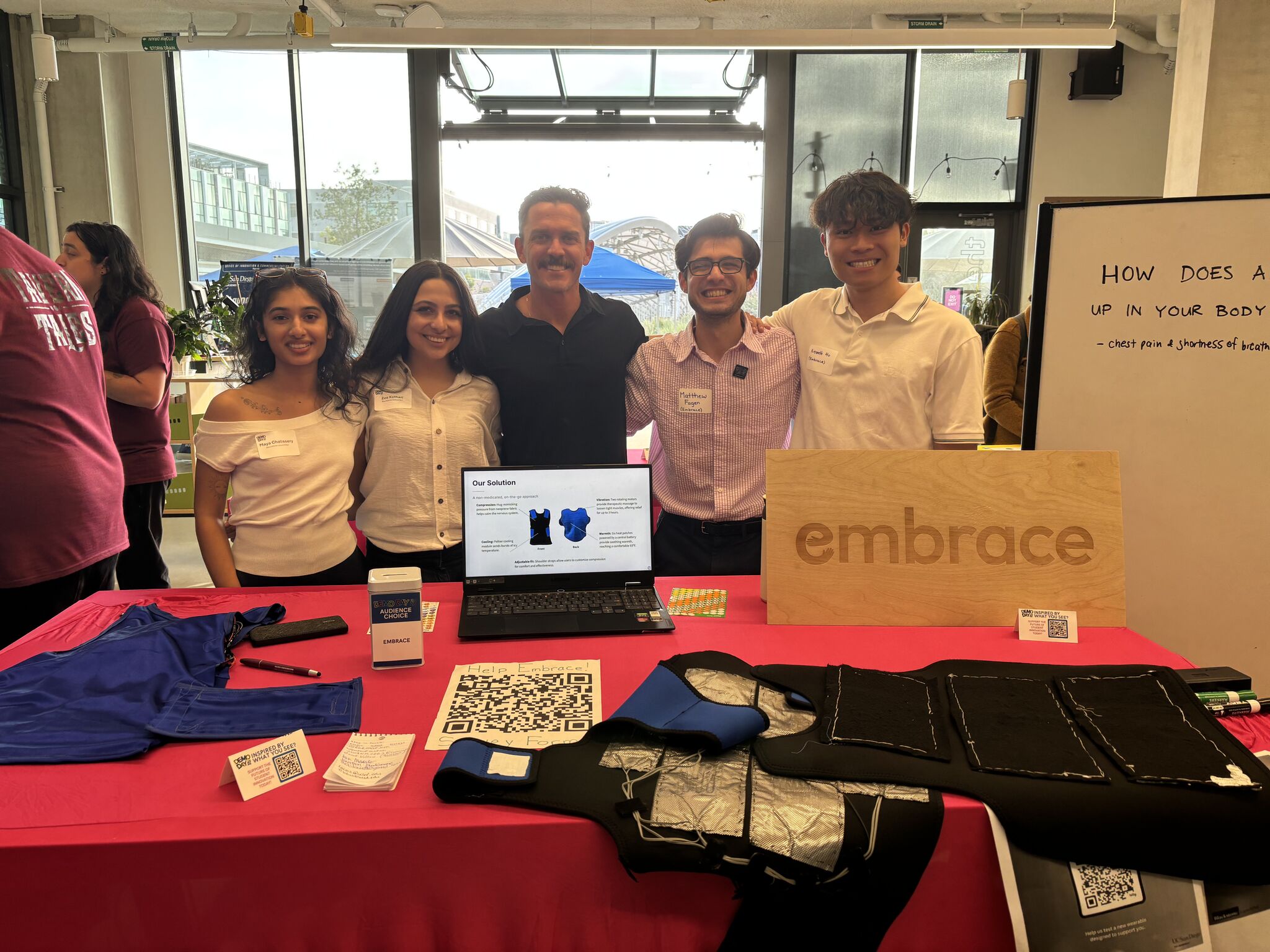
Reflections
This product started as a personal frustration. I grew up with moderate to severe social anxiety, the kind that made me skip school, shrink from moments I knew I could have excelled in, and search for anything that would quiet the shaking, the nausea, the adrenaline that felt impossible to outrun. Medication wasn't the right fit for me. Therapists were hard to find. And so I learned to reach for the things that helped: a comforting hug, cold showers, a massage gun for tight muscles. Eventually, I started asking why those things existed only at home and in private.
Pitching that question in a room of strangers, and watching people stop, lean in, and say "I need that," was one of the most validating experiences of my life. That question became something I started sharing, and it quickly turned into a shared direction with a team of five, now four, as we continued shaping it together. We built, researched, prototyped, and kept refining the idea through constant questions about what would actually hold up in real life. What followed was two years of user research, hardware prototyping, pivots, selection into UC San Diego's Blackstone Launchpad incubator, and conversations with investors, clinicians, and people who knew exactly what it takes to bring something like this to market. We're still building. But what stays with me most is how something born from a deeply uncomfortable personal experience became something other people could see themselves in, and something I genuinely hope makes the hard moments a little more manageable for someone who, like me, didn't have many options.